
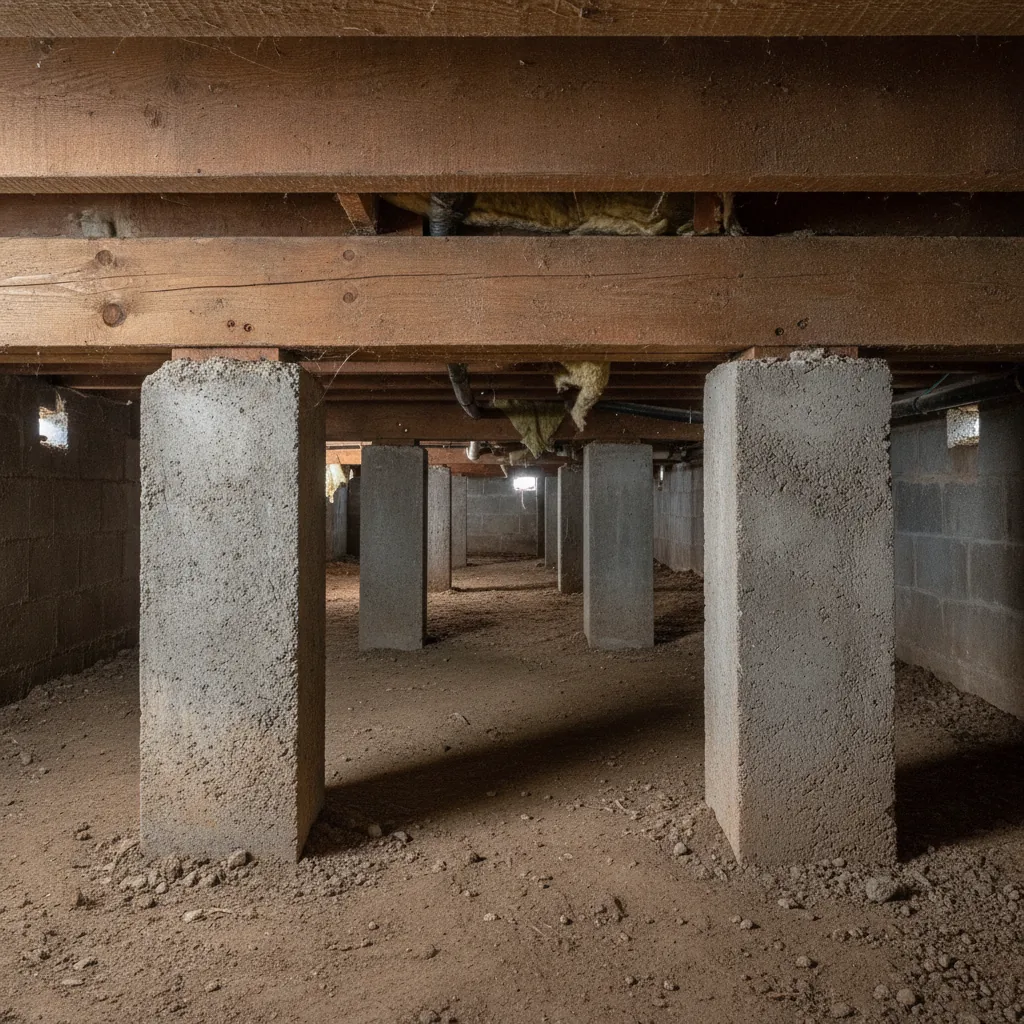
There are two broad ways to put a house on the ground, and they lead to very different homes. One sets the structure on a raised framework with a crawl space underneath; the other pours the house directly onto a concrete slab. If you own a home in Mesa, you almost certainly have the second kind — but it helps to understand both, because the type of foundation you have shapes how it moves and how it gets fixed.
Pier and Beam vs. Slab Foundations
A pier and beam foundation raises the house off the ground. Concrete piers (or footings) are set into the soil, wooden or steel beams span between them, and the floor structure sits on top of the beams. That leaves a crawl space — an accessible gap, usually a couple of feet, between the ground and the underside of the house. You can physically get under the home to reach plumbing, wiring, and the floor framing.
A slab-on-grade foundation is the opposite. A single reinforced concrete slab is poured directly on prepared ground, and the house is built right on top of it. There is no crawl space and no gap; the concrete is both the foundation and the ground floor. Plumbing and utilities run through or under the slab, embedded in the concrete.
Both are legitimate, proven ways to build. Which one makes sense depends heavily on climate, soil, and local building practice — which is why the answer looks so different in Arizona than it does in, say, the humid South.
Which Is Common in Arizona
In Arizona, slab-on-grade dominates, especially across the East Valley. Walk through Mesa, Gilbert, Chandler, or Queen Creek and the overwhelming majority of homes — particularly everything built from the 1980s onward — sit on concrete slabs, many of them post-tension slabs designed for our expansive soil.
There are a few practical reasons slab won out here:
- The dry climate. Slab foundations do best where moisture is not constantly attacking them, and Arizona’s aridity suits them. Regions with high water tables or frequent flooding often favor raised foundations instead.
- Cost and speed. Pouring a slab is generally faster and cheaper than building a raised pier and beam structure, which matters at the scale Valley tract homes were built.
- No freeze concerns. Much of the country needs foundations below the frost line; Arizona does not have that problem.
You will still find pier and beam and crawl-space construction in Arizona — some older homes, certain custom builds, and hillside or sloped lots where a slab is impractical. But for the typical Mesa homeowner, slab-on-grade is the reality, which is why the bulk of foundation work here is slab foundation repair and stem-wall work rather than crawl-space repair.
Pros and Cons of Each
Neither type is simply better. They trade off differently.
Slab-on-grade
Advantages: lower cost, faster construction, no crawl space for pests or moisture to collect in, and a solid concrete base that sits low to the ground. On expansive soil, a well-built post-tension slab spans movement well.
Drawbacks: utilities are embedded in or under the concrete, so a plumbing leak under the slab is harder and more invasive to reach. When the soil moves, the slab moves with it, and repairs mean working with the concrete itself. There is no easy access underneath.
Pier and beam
Advantages: the crawl space gives easy access to plumbing, wiring, and floor framing, which makes many repairs and modifications simpler. The raised structure keeps the living floor up off the soil and can flex with some ground movement. Individual piers can sometimes be adjusted.
Get Your Foundation Looked At
A quick inspection tells you what is really going on beneath the surface — and we will send a written estimate.
→ Request a Written EstimateDrawbacks: more expensive and slower to build, the crawl space can harbor moisture, pests, or ventilation problems, and floors can feel bouncier. Wooden components under the house can rot or attract termites if moisture is not managed.
How Each Type Is Repaired
The repair approach follows directly from the construction.
Slab foundations are repaired by addressing the concrete and the soil under it. Depending on the problem, that means sealing and reinforcing cracks, lifting a settled section back to grade and stabilizing the void beneath it, restoring a corroded stem wall, or improving drainage so the soil stops swinging. Because everything is tied to the slab and the ground it rests on, the work is about stabilizing that concrete-and-soil system. On a post-tension slab, the tendons must be located before any cutting.
Pier and beam foundations are repaired from the crawl space. Because the structure is accessible, technicians can reach the piers and beams directly — re-shimming or adjusting a settled pier, replacing a failed pier or a rotted beam, adding support, or re-leveling the floor framing. The accessibility is a real advantage for this kind of work.
The common thread is that the fix has to match how the house is built. In Mesa, that overwhelmingly means slab work, and it means understanding our specific soil — the expansive clay and caliche that drive most local foundation movement. Mesa Foundation Repair Co. is a local, homeowner-first foundation crew, and we work on the foundation types Arizona homes actually have. If you are not sure what is under your home, or you are seeing signs of movement and want a straight assessment, get a written estimate and we will start by confirming exactly how your home is built.
Frequently Asked Questions
Do Arizona homes have slab or pier and beam foundations?
The overwhelming majority of Arizona homes, especially in the East Valley and everything built from the 1980s onward, are slab-on-grade, many of them post-tension slabs suited to our expansive soil. Pier and beam and crawl-space construction exists here in some older homes, custom builds, and sloped lots, but slab dominates.
Is a slab foundation harder to repair than pier and beam?
Not harder, just different. Pier and beam repairs are done from an accessible crawl space, so piers and beams can be reached directly. Slab repairs work with the concrete and the soil under it, addressing cracks, settlement, and drainage. Each approach matches how the home is built, and both are routine for an experienced contractor.
Why is slab-on-grade so common in Arizona?
The dry climate suits slab foundations, there is no frost line to build below, and pouring a slab is faster and cheaper than building a raised pier and beam structure, which mattered at the scale Valley tract homes were built. Well-built post-tension slabs also span expansive-soil movement well.
How can I tell which foundation type my home has?
If your home sits low to the ground with no crawl space and the ground floor is essentially at grade, it is almost certainly slab-on-grade. If there is an accessible gap under the house you can crawl into, it is pier and beam. Building records or plans confirm it, and a contractor can verify it on a site visit.