
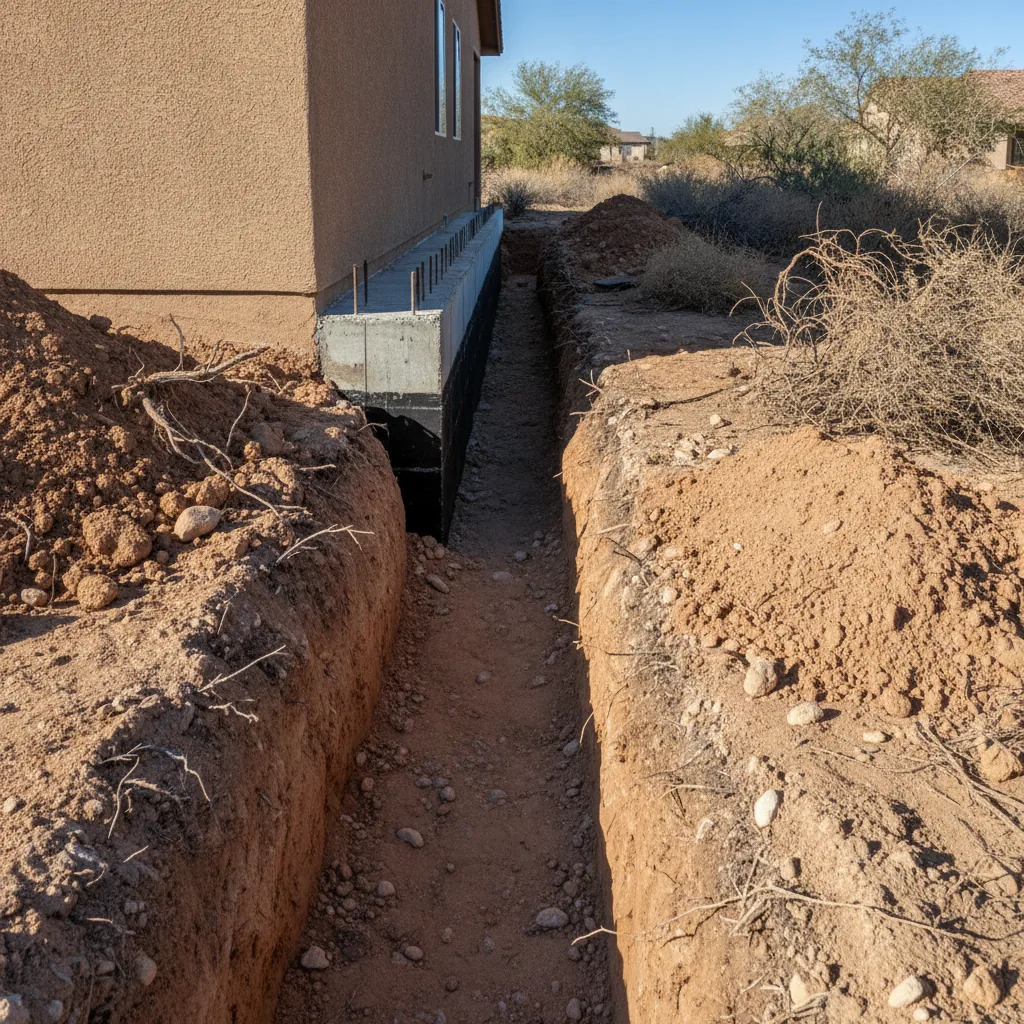
When a homeowner finds out their foundation is moving, one of the first fears is the big one: do I have to replace the whole thing? It is a reasonable worry, because full foundation replacement is enormously expensive and disruptive. It is also, for the overwhelming majority of homes, completely unnecessary.
Here is the honest version of how to think about repair versus replacement, so you can walk into any estimate knowing what is actually on the table.
Foundation Repair vs. Replacement: The Short Answer
For the vast majority of Mesa homes with foundation problems, a targeted repair is the right answer — sealing and reinforcing cracks, restoring a spalling stem wall, stabilizing a settled section, or lifting a slab back to grade. Full replacement is rare and reserved for foundations that are so extensively failed that fixing individual problems no longer makes structural or financial sense. If someone is quoting you a replacement or a whole-house pier system for a handful of cracks, that is your cue to get a second opinion.
When Repair Is Enough
Most foundation problems are localized. Something specific happened in one area — the soil under a corner washed out, a stem wall corroded, a slab section settled — and the fix targets that specific problem while leaving the sound majority of the foundation alone. This is the case for the large majority of homes we see.
Repair is typically enough when:
- The damage is confined to one area or a few spots rather than being uniform across the whole foundation.
- The cracks are treatable — even fairly serious cracks can often be stabilized with proper structural reinforcement rather than replacement.
- A stem wall is spalling from rebar corrosion, which is restored section by section, not by rebuilding the foundation.
- A slab has settled and can be lifted and the underlying soil stabilized.
- The structure above is fundamentally sound and just needs the movement underneath it stopped.
The goal of a good repair is always to address the cause — usually soil and water behavior — not just cosmetically patch the symptom. A crack filled without stopping the movement behind it will simply reopen. Done right, targeted foundation settlement repair stabilizes the home for the long term at a fraction of a replacement’s cost and disruption.
When Full Replacement Is Necessary
Replacement is genuinely warranted only in a narrow set of severe situations. It usually means lifting the house off its foundation, removing the old concrete, and building a new foundation underneath — a massive undertaking. It is on the table when:
- The damage is extensive and widespread, not localized — the entire foundation is failing rather than one section.
- The concrete itself has deteriorated throughout, such as severe, pervasive corrosion or crumbling that reinforcement cannot restore.
- The foundation was fundamentally under-built or defective for the site and soil, so repairs would only be patching a design that cannot hold.
- Multiple failed prior repairs have left the structure in a condition where piecemeal fixing no longer makes sense.
Even in most of these cases, a competent structural assessment looks hard for a repair path first, because replacement is the last resort by cost and disruption, not the default. The honest reality is that a home needing true full replacement is uncommon.
Cost and Disruption Compared
The gap between the two is not small, and it is the reason getting the diagnosis right matters so much.
Repair is generally measured in a range from modest to moderate depending on scope. Many repairs are completed in a day or a few days, you usually stay in your home, and the disruption is limited to the work area. Crack repairs can be a matter of hours; a stem wall or a slab lift, a few days.
Get Your Foundation Looked At
A quick inspection tells you what is really going on beneath the surface — and we will send a written estimate.
→ Request a Written EstimateReplacement is in an entirely different league — often many times the cost of a repair, plus the house has to be lifted and supported, utilities disconnected, and you typically cannot live in it during the work, which stretches to weeks. Between the direct cost and the temporary relocation, it is the outcome everyone wants to avoid, which is exactly why so many franchise sales pitches lean toward the biggest system they can justify.
Because the numbers are so far apart, the single most valuable thing you can do is get an accurate, honest diagnosis before committing to anything. We give you a real cost picture in writing; you can see typical ranges on our foundation repair cost page.
How to Decide
You do not have to make this call from a place of fear or guesswork. Here is a sensible path:
- Get a proper structural assessment first. Not a sales walkthrough disguised as a free inspection, but an actual diagnosis of what is moving and why. Written findings, not verbal scare tactics.
- Ask specifically whether a targeted repair is possible and, if the answer is no, exactly why the whole foundation must be replaced. A good contractor can explain it plainly.
- Get a second opinion on any replacement quote. If one company says replace and another says a targeted repair will hold, that gap is worth investigating before you spend five or six figures.
- Weigh the numbers against your home’s value and your plans, but do not let anyone rush the decision with a same-day discount.
Our whole approach is built on right-sizing the fix. Mesa Foundation Repair Co. diagnoses the real problem and quotes the repair your home actually needs — which is very rarely a replacement. If you have been told you need to replace your foundation, or you just want a straight answer on whether a repair will hold, get a written estimate and a second opinion you can trust.
Frequently Asked Questions
Do most foundation problems require full replacement?
No. The overwhelming majority of foundation problems are localized and fixable with a targeted repair, such as stabilizing cracks, restoring a stem wall, or lifting a settled slab. True full replacement is rare and reserved for foundations that have failed extensively throughout. If you are quoted a replacement for a few cracks, get a second opinion.
How much more does replacement cost than repair?
Replacement typically runs many times the cost of a repair. Beyond the direct expense, the house has to be lifted and supported, utilities disconnected, and you usually cannot live in it during weeks of work, so relocation costs add up too. That enormous gap is exactly why an accurate diagnosis matters so much.
How do I know if my quote is honest?
Ask specifically whether a targeted repair is possible and, if not, exactly why the whole foundation must be replaced. A trustworthy contractor gives you written findings and can explain the reasoning plainly. Any replacement quote is worth a second opinion, especially if it comes with same-day-discount pressure.
Can a badly cracked foundation still be repaired?
Often, yes. Even fairly serious cracks can frequently be stabilized with proper structural reinforcement rather than replacement, as long as the concrete itself has not deteriorated throughout and the damage is not uniform across the entire foundation. A structural assessment determines whether repair will hold.