
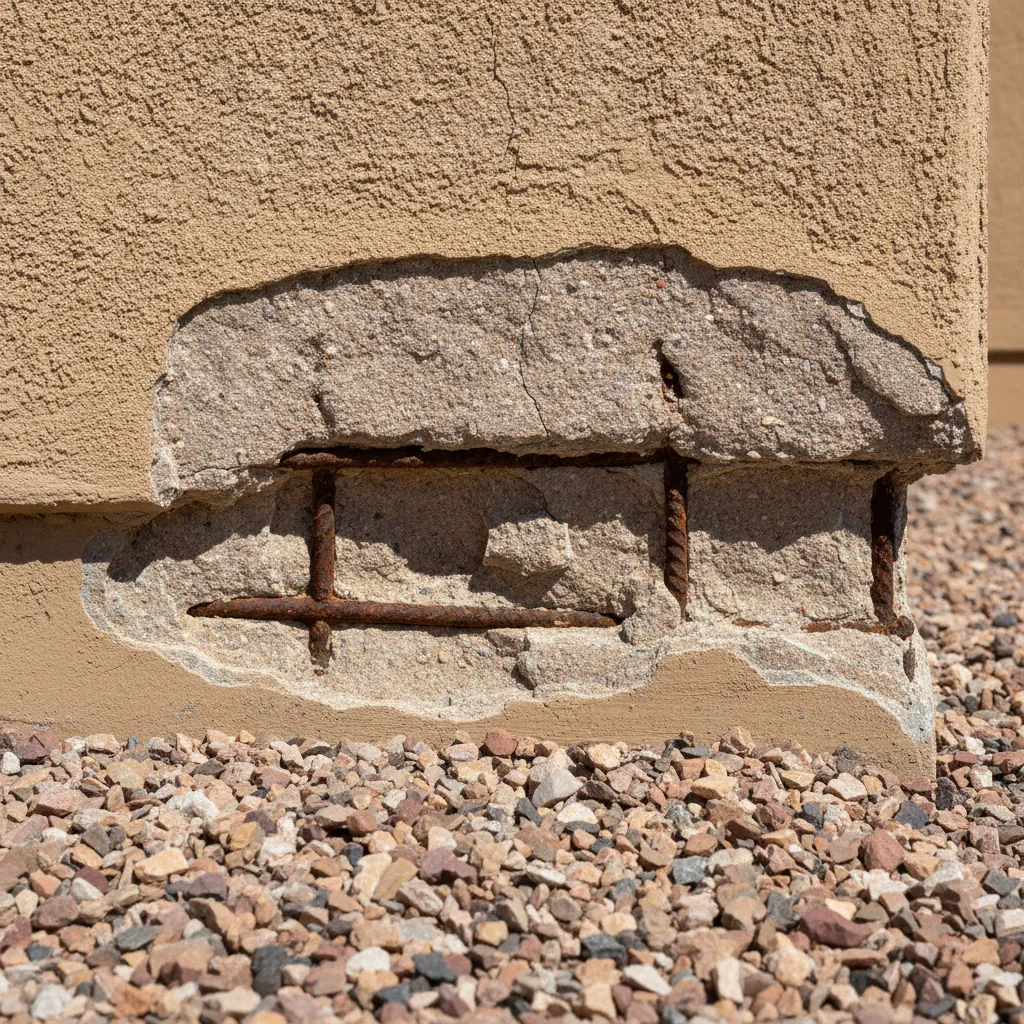
If you have noticed the concrete at the bottom of an exterior wall starting to flake, crumble, or crack in horizontal lines — sometimes with a rusty stain bleeding through — you are looking at one of the most common foundation problems in Mesa. It is called stem wall spalling, and it shows up in thousands of East Valley homes built between the 1980s and the early 2000s.
It looks alarming, and left alone long enough it does become a structural issue. But it is also one of the more predictable and repairable problems we deal with. Here is what is actually happening inside that wall.
What a Stem Wall Is and Why Arizona Homes Have Them
A stem wall is the short concrete wall that sits between your home’s footing, down in the ground, and the wood framing above. Picture the perimeter of your house: the footing is buried in the soil, the stem wall rises up out of it, and your framed walls are anchored on top. It is the transition piece that keeps your wood structure up off the dirt.
Inside that concrete runs steel reinforcing bar — rebar — that gives the wall its tensile strength. This construction is extremely common across Mesa, Gilbert, Chandler, and the rest of the Valley, especially in the tract homes built through the 80s, 90s, and early 2000s. It is a perfectly sound way to build. The problem is what Arizona’s conditions eventually do to the steel inside.
Why Rebar Corrodes and Concrete Spalls in the Desert
Here is the part that surprises people: the concrete does not fail first. The steel does, and the concrete just goes along for the ride.
Fresh concrete is highly alkaline, and that alkalinity forms a protective film around the rebar that keeps it from rusting. Over decades, two things eat away at that protection:
- Carbonation. Carbon dioxide from the air slowly penetrates the concrete and neutralizes its alkalinity. As the protective chemistry breaks down, the steel loses its shield.
- Moisture intrusion. Water reaches the rebar through hairline cracks, from irrigation and monsoon splash at the base of the wall, and through soil contact. Once moisture and oxygen reach unprotected steel, it rusts.
And here is the mechanism that does the visible damage: rust takes up far more space than the original steel — several times the volume. As the rebar corrodes and expands, it pushes outward against the concrete surrounding it with enormous force. The concrete cannot take that pressure, so it cracks, delaminates, and eventually flakes off in sheets. That flaking is spalling, and once the surface pops off, the now-exposed rebar corrodes even faster. It is a cycle that feeds itself.
People assume the dry desert would protect steel, but the constant wet-dry swing at the base of a wall — irrigation, monsoon runoff, sprinkler overspray, soil that holds moisture against the concrete — is actually a demanding environment for reinforced concrete. That is why stem wall repair is one of the signature jobs in this part of Arizona.
Early Warning Signs of Stem Wall Failure
Caught early, spalling is a straightforward repair. Caught late, after the rebar has lost significant cross-section, it is a bigger job. So it pays to know what to watch for at the base of your exterior walls:
- Horizontal cracks running along the wall a few inches above the soil line — a telltale sign the rebar underneath is expanding.
- Flaking or crumbling concrete that comes off in chips or sheets when you touch it.
- Rust stains bleeding out through the concrete surface or streaking down from a crack.
- Exposed rebar — visible steel where the concrete face has already fallen away.
- Bulging or a raised ridge in the wall surface where corrosion is pushing the concrete outward from within.
The soil-line zone is where it almost always starts, because that is where moisture concentrates. If you walk your home’s perimeter once a year and check that band of concrete, you will usually catch it while it is still small.
How Stem Wall Damage Is Repaired
A proper stem wall repair addresses the steel, not just the surface. Patching over the flaking concrete without dealing with the rusting rebar underneath is the classic shortcut that fails within a year — the corrosion keeps going and the patch pops right back off.
Get Your Foundation Looked At
A quick inspection tells you what is really going on beneath the surface — and we will send a written estimate.
→ Request a Written EstimateDone correctly, the repair generally follows these steps:
- Remove the failed concrete down to sound material, exposing the corroded rebar fully.
- Treat or replace the steel. The rust is cleaned off the rebar, and where the steel has lost too much material, additional reinforcement is added.
- Apply a corrosion-inhibiting treatment so the newly exposed steel does not simply start rusting again.
- Rebuild the wall profile with a structural repair mortar bonded to the sound concrete, restoring the wall to its original dimensions and strength.
In some cases the reinforcement is upgraded with modern corrosion-resistant materials so the repaired section outlasts the original. The right approach depends on how far the corrosion has progressed, which is exactly why a real diagnosis comes before any quote. Mesa Foundation Repair Co. has done this repair on Mesa homes for decades and will scope it to what your wall actually needs.
Preventing Future Corrosion
Once a wall is repaired, or if you want to protect a healthy one, prevention comes down to keeping moisture away from that soil-line band:
- Redirect irrigation and sprinklers so they are not spraying or pooling against the stem wall.
- Grade the soil to slope away from the base of the wall, and keep soil and mulch from piling up against the concrete.
- Seal hairline cracks before they let water reach the rebar.
- Fix downspouts and drainage so roof runoff is not hitting the wall base every time it rains.
- Apply a breathable protective coating where appropriate to slow carbonation and moisture entry.
Stem wall spalling is common in Mesa, but it is not a reason to panic. It moves slowly, it announces itself well before it becomes structural, and it has a well-understood fix. If you are seeing flaking concrete or rust stains at the base of your walls and want to know how far along it is, get a written estimate and we will give you a straight assessment — small problem or large, we will tell you honestly which one you have.
Frequently Asked Questions
Is stem wall spalling a serious problem?
It depends on how far it has progressed. Early on, when only the surface concrete is flaking, it is a manageable repair. Left for years, the rebar can lose enough cross-section to become a structural concern. The key is that it moves slowly and is very treatable when caught before the steel is badly compromised.
Why is the concrete flaking off the bottom of my wall?
Almost always because the rebar inside is rusting. Rust expands to several times the volume of the original steel, and that pressure pushes the surrounding concrete apart until it cracks and flakes off. The flaking is a symptom; the corroding steel is the cause.
Can I just patch over spalling concrete myself?
Patching the surface without treating the rusting rebar underneath is the most common way these repairs fail. The corrosion keeps advancing and pushes the patch right back off, usually within a year. A lasting repair has to expose the steel, treat or reinforce it, then rebuild the wall.
Why does this happen so much in Arizona?
The constant wet-dry cycling at the base of exterior walls from irrigation, monsoon runoff, and sprinkler overspray, combined with decades of carbonation, breaks down the concrete’s natural protection of the rebar. It is especially common in Mesa-area homes built from the 1980s through the early 2000s.