
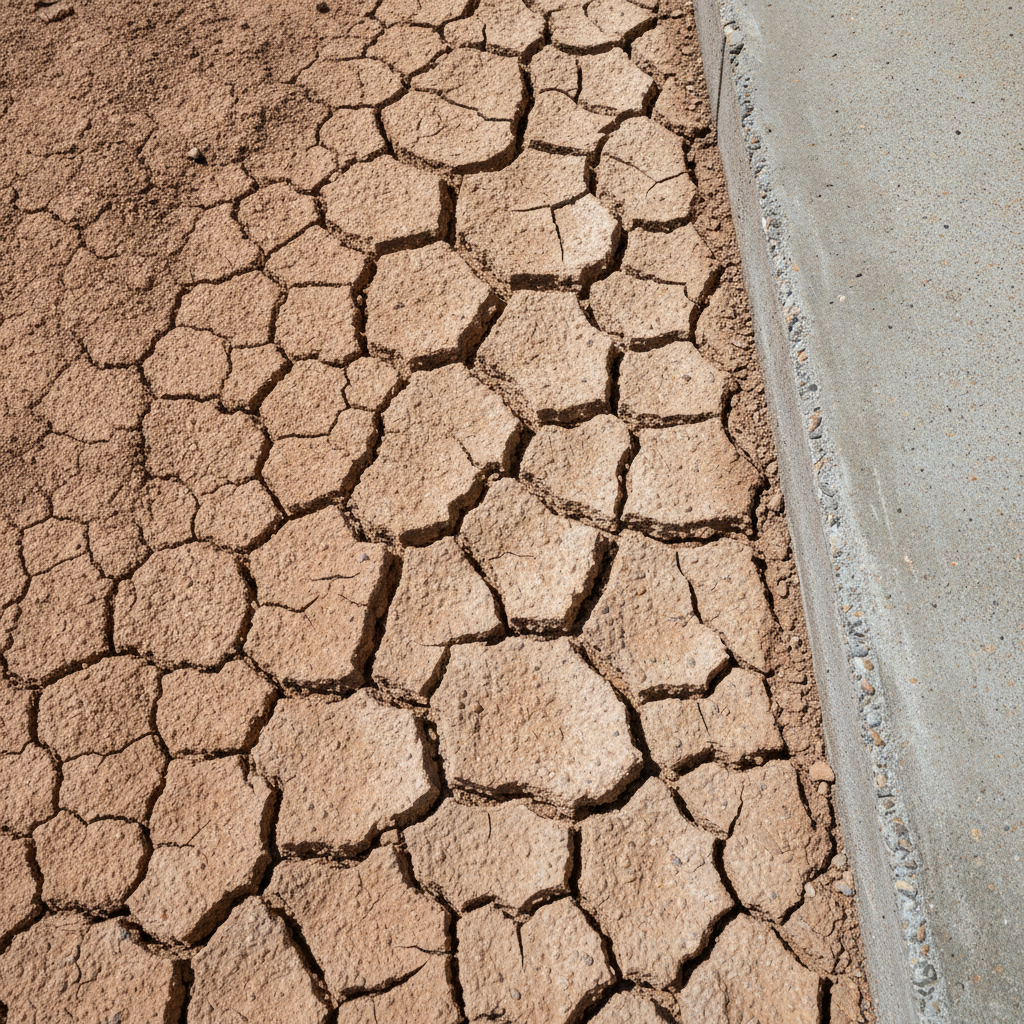
If you own a home in Mesa long enough, you will probably see a crack somewhere — a hairline over a doorway, a step in the block wall out back, a gap opening where the baseboard meets the tile. It is unsettling. But before you picture the worst, it helps to understand what is actually happening under the slab, because in Arizona the story almost always starts with the soil.
Our desert ground is not the stable, sandy stuff people imagine. Much of the Valley sits on expansive clay and caliche, soils that swell and shrink with moisture more dramatically than the soil in most of the country. That movement is the single biggest reason foundations crack here, and it is why a repair approach built for Ohio or Texas does not quite fit a Mesa home.
Why Arizona Desert Soil Cracks Foundations
A foundation does not fail because concrete is weak. It cracks because the ground beneath it does not hold still. When soil swells, it lifts parts of the slab; when it dries and shrinks, it pulls that support back out and the slab settles into the void. Do that a few thousand times over a couple of decades and something eventually gives — usually the least flexible part of the structure, which is the concrete.
In the East Valley, three ingredients make that movement worse than average: the clay content of the soil, the layer of rock-hard caliche that traps and redirects water, and a climate that swings from bone-dry to monsoon-soaked and back every year.
Expansive Clay vs. Collapsible Soil
Not all problem soil behaves the same way, and the difference matters for how a home moves.
Expansive clay
Clay particles grab water and hold it, swelling as they do. When a dry spell follows, they release it and contract. A home sitting on expansive clay is essentially riding a slow, seasonal tide — up in the wet months, down in the dry ones. The corners and edges of a slab feel this most, which is why stair-step cracks so often show up near doors and windows.
Collapsible soil
Some desert soils are the opposite: loosely packed and stable while dry, but they lose structure the moment they get thoroughly wet and compress under the weight of the house. A plumbing leak or a badly aimed downspout can saturate a spot, the soil collapses, and that part of the foundation drops.
Plenty of Mesa lots have a bit of both, which is exactly why an honest inspection matters more than a quick guess.
How the Monsoon and Drought Cycle Moves Your Slab
Arizona’s weather is the engine that drives all of this. For most of the year the ground is dry and shrinking. Then the monsoon arrives and dumps an inch of rain in an afternoon onto soil that cannot absorb it quickly. Water pools against foundations, runs along caliche layers, and soaks in unevenly — wetting one side of a home while the other stays dry.
That uneven wetting and drying is far harder on a foundation than steady moisture would be. One corner heaves while another settles, and the slab has to twist to keep up. Add in decades of irrigation, a pool, or a leaky drip line, and you have localized moisture swings happening year-round.
Signs the Soil Is Affecting Your Foundation
Soil movement shows up in predictable places. Any one of these on its own may be cosmetic; several together are worth a closer look:
- Stair-step cracks in block walls or stucco, especially near openings.
- Doors and windows that stick or no longer latch the way they used to.
- Sloping or uneven floors, or tile and grout that cracks in a line.
- Gaps opening where walls meet ceilings, or trim pulling away from the wall.
- Spalling stem walls — flaking concrete at the base of exterior walls that exposes rusting rebar.
That last one is worth flagging, because in Arizona a cracked stem wall is one of the most common failures we see, and it is driven by the same moisture that moves the soil.
Get Your Foundation Looked At
A quick inspection tells you what is really going on beneath the surface — and we will send a written estimate.
→ Request a Written EstimateHow Mesa Foundations Are Protected and Repaired
The good news: soil-driven movement is manageable, and not every crack means a major repair. The fix depends entirely on what is actually moving and why, which is why we diagnose before we quote. Depending on the problem, the right answer might be sealing and reinforcing a crack, restoring a spalling stem wall, lifting a settled slab back to grade, or improving drainage so the soil stops swinging so hard in the first place.
What all of those have in common is that they address the cause — the soil and the water — rather than just skimming over the symptom. A crack filled without fixing the movement behind it will simply open again next monsoon.
When to Get an Inspection
If you are seeing one small hairline and nothing else, it is reasonable to keep an eye on it. If cracks are widening, doors are sticking, or you can see daylight or rusting steel in a stem wall, it is worth having someone who knows Arizona soil take a look. A good foundation inspection tells you plainly whether what you are seeing is cosmetic or structural — and if it is nothing, we will tell you that too.
No scare tactics, no pressure. Just a straight read on what the ground is doing under your home, and a written estimate if anything actually needs fixing.
How Arizona’s Desert Soil Mechanically Cracks a Foundation
The specific culprit under most Mesa homes is expansive clay soil. When the monsoon and irrigation wet it, the clay swells and pushes up on the slab or footing; when the long dry season bakes it, the same clay shrinks and pulls away in a process called desiccation. Because that wetting and drying is never uniform across a lot — one corner drains, another stays shaded and damp — the soil lifts and drops unevenly. That uneven movement is differential settlement, and it is what actually cracks concrete: a slab-on-grade foundation flexes until the concrete gives, and a stem wall shears where the movement concentrates. Understanding this cycle is why the right repair addresses the soil-and-moisture cause, not just the visible crack.
Frequently Asked Questions
Is it normal for foundations to crack in Arizona?
Small shrinkage and settlement cracks are extremely common here because of how much our clay and caliche soils move with moisture. What matters is the type, width and pattern of the crack — many are cosmetic, but some signal structural movement worth addressing.
Does watering my foundation actually help?
In a controlled way, yes. Keeping soil moisture consistent around the home — rather than letting it swing from bone-dry to soaked — reduces the swelling and shrinking that stresses a slab. Poorly aimed irrigation that soaks one spot can do the opposite, so consistency and drainage are the goal.
How can I tell if a crack is from soil movement or something serious?
Stair-step cracks near doors and windows, cracks wider than about a quarter inch, doors that suddenly stick, and sloping floors all point to movement worth inspecting. A written inspection is the reliable way to know whether it is cosmetic or structural.
Can foundation movement from desert soil be stopped?
You can’t stop the soil from being expansive, but you can dramatically reduce the movement with proper drainage, grading and consistent moisture — and repair the damage that has already happened so it doesn’t progress.